The USTA's adult NTRP guide describes tennis levels from 1.5 to 7.0, with higher numbers indicating stronger play. Stakhovsky Tennis uses those characteristics to explain the differences between 3.0, 3.5 and 4.0. UTR, WTN, German LK and the French classement use different scales and rules. There is no universal one-to-one conversion, and this page's self-check does not award an official rating.
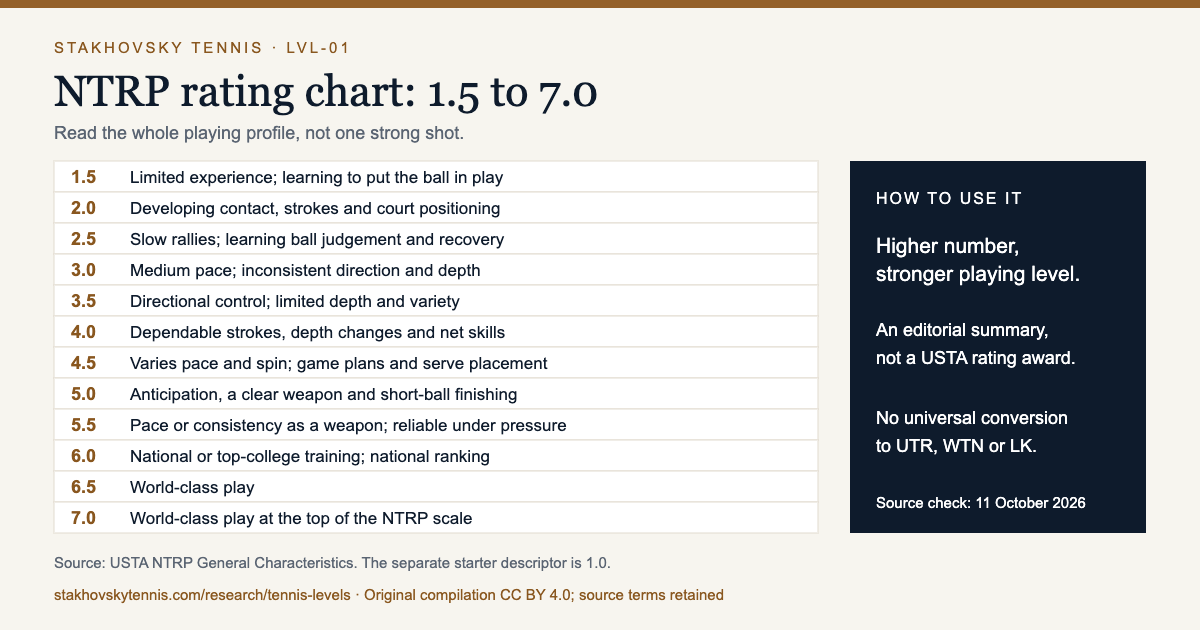
NTRP rating chart: 1.5 to 7.0
Read the whole playing profile, not one strong stroke. The following short descriptions summarise the USTA's general characteristics. That document also lists 1.0 for someone just starting; the USTA's adult rating overview starts at 1.5.
| NTRP | Playing characteristics |
|---|---|
| 1.5 | Learning to put the ball in play; limited stroke experience. |
| 2.0 | Developing contact, strokes and court positioning. |
| 2.5 | Can sustain slow rallies; learning ball judgement and recovery. |
| 3.0 | Medium-paced rallies are possible; direction and depth remain inconsistent. |
| 3.5 | Directional control at moderate pace; limited depth and variety. |
| 4.0 | Dependable strokes on both sides; changes depth and uses net skills. |
| 4.5 | Varies pace and spin; develops game plans and effective serve placement. |
| 5.0 | Anticipates well; builds around a weapon and finishes short balls. |
| 5.5 | Pace or consistency is a weapon; dependable under competitive pressure. |
| 6.0 | Intensive national or top-college training and a national ranking. |
| 6.5 | World-class play in the USTA description. |
| 7.0 | World-class play at the top of the NTRP scale. |
What is a 3.0 tennis player?
A 3.0 player can rally at medium pace but does not yet control every shot reliably. A comfortable forehand rally does not establish the same level on returns, low balls or the backhand. Look at ordinary match play rather than a cooperative warm-up.
What is a 3.5 tennis player?
A 3.5 player has better directional control at moderate pace. Depth and variety remain less reliable, and doubles teamwork is still developing. In a coaching assessment, compare the shots that start a point with the next ball: a serve that lands is different from a serve that creates a manageable reply.
What is a 4.0 tennis player?
A 4.0 player can change depth with dependable strokes on both sides during moderate play. Approach shots, lobs, overheads and volleys can be used successfully. The distinction from 3.5 is the repeatability of a wider game, not a required serve-speed reading.
What is NTRP in tennis?
NTRP means National Tennis Rating Program. The USTA uses it for level-based adult competition. Its rating overview describes half-point levels and explains how adult league results contribute. Follow the applicable USTA self-rating and league rules; an online quiz or private coach cannot issue a USTA computer rating.
NTRP, UTR, WTN, LK and the French classement
| System | Scale and direction | What to check |
|---|---|---|
| NTRP · USTA | 1.5–7.0 in the adult overview; higher is stronger | Your rating type and league eligibility |
| UTR · UTR Sports | 1.00–16.50; higher is stronger | Rating versus Verified UTR and eligible results |
| WTN · ITF | 40 toward 1; lower is stronger | Singles/doubles number and confidence level |
| LK · DTB | Classes 25 toward 1; regular calculation capped at 1.5, with fixed top-rank exceptions | Current published LK and competition rules |
| Classement · FFT | Named levels and national ranks; not a decimal scale | Current Ten'Up record, including the fifth series |
UTR's algorithm FAQ describes a rolling twelve-month window and normally up to 30 eligible results, with a same-day boundary exception. It distinguishes UTR from Verified UTR. The ITF's WTN guide describes separate singles and doubles numbers updated on Wednesdays. For the broader context, read our UTR rating chart and evidence limits.
Is level 6 or 7 better? Seven is stronger in NTRP; six is stronger in WTN and LK. Always name the system.
Can you convert NTRP to UTR or WTN?
No universal one-to-one conversion is established by these sources. USTA Northern California's Generation Gap guidance provides the following ranges for its event. They overlap and separate men and women; they are not national eligibility rules.
| NTRP | Men's UTR range | Women's UTR range |
|---|---|---|
| 4.0 | 6–8 | 4–6 |
| 4.5 | 8–10 | 6–8 |
| 5.0 | 10–12 | 8–10 |
| 5.5+ | 11+ | 9+ |
Use your actual WTN record rather than deriving a World Tennis Number from this table.
German LK and French tennis ratings
The DTB's LK rules describe classes 1–25 and a weekly calculation cycle. Regular calculation stops at 1.5; section 10 allows fixed values below 1.5 for leading nationally ranked players. Calling 1.5 the absolute best possible LK would miss that exception.
France's system is not simply a list beginning at 40. The FFT introduced a fifth series on 1 July 2025. Its 24 June 2025 announcement sets out the entry rules below; these are not NTRP equivalents.
| FFT level | Series | Published entry condition |
|---|---|---|
| 40/2 | Fifth | At least four approved match wins in the previous twelve months |
| 40/1 | Fifth | Eight wins; walkovers excluded |
| 40 | Fourth | Remains in the fourth series; separate entry conditions apply |
The FFT club guide explains monthly publication and points from eligible wins. Check Ten'Up for your record and current rules instead of converting a French level from NTRP.
Serve speed by NTRP level
Serve speed alone cannot assign an NTRP level. Placement, second-serve reliability, returns and rally control also matter. App measurements, radar readings and tournament broadcasts are not automatically comparable. Our tennis serve-speed reference keeps source samples and measurement methods separate.
What tennis level am I? A quick self-check
Choose one answer per question based on normal match play, not your best day. This Stakhovsky Tennis editorial tool is an unvalidated, unofficial estimate limited to 2.5–5.5. It is not a USTA rating and cannot assess the entire 1.5–7.0 scale. No answers are stored or sent anywhere.
Playing history alone does not establish your current level. The fourth answer is only one input to this simple heuristic.
No estimate yet. Automatic scoring requires JavaScript; the chart and questions remain available without it.
How the self-check is calculated
Answers A–F receive these scores: questions 1 and 3 use 2.5, 3.0, 3.5, 4.0, 4.5, 5.0; question 2 ends at 5.5; question 4 uses 2.5, 3.0, 3.5, 4.0, 5.0, 6.0. Average all four scores, then round to the nearest half-point. Exact quarter-point ties round down. This editorial scoring rule has not been validated against USTA ratings.
How to move up one tennis level
Start with the points you repeatedly lose, then choose a measurable practice task. Record second-serve faults, short returns or rally errors under comparable conditions. Recheck those measures in matches; do not assume a faster serve will automatically change a rating.
Stakhovsky Tennis offers private adult coaching in Prague and a 90-minute tennis performance assessment. The assessment costs 3,800 CZK (≈ €155), with court fees separate. If you continue, the assessment fee is credited toward the first programme period; training blocks are quoted separately. It can inform a technical plan, but it does not award an official NTRP rating or guarantee a rating increase.
Method and limitations
Stakhovsky Tennis compiled this editorial reference from USTA, UTR Sports, ITF, DTB and FFT sources checked on 11 October 2026. Source publication dates, where supplied, remain separate from our check date. The NTRP chart summarises characteristics, not a population distribution. Regional event guidance is not a universal conversion.
The self-check weights four answers equally. It cannot assess health, readiness for competition, strokes on video or the strength of your opponents. It is a conversation starter, not a validated test, medical assessment or governing-body decision.
Download and cite the tennis levels chart
Download the source-labelled chart, scale notes and regional ranges. The CSV has a normal header row; the JSON includes licence and scope metadata. Original compilation and annotations are CC BY 4.0. Third-party facts and descriptions remain subject to their source terms.
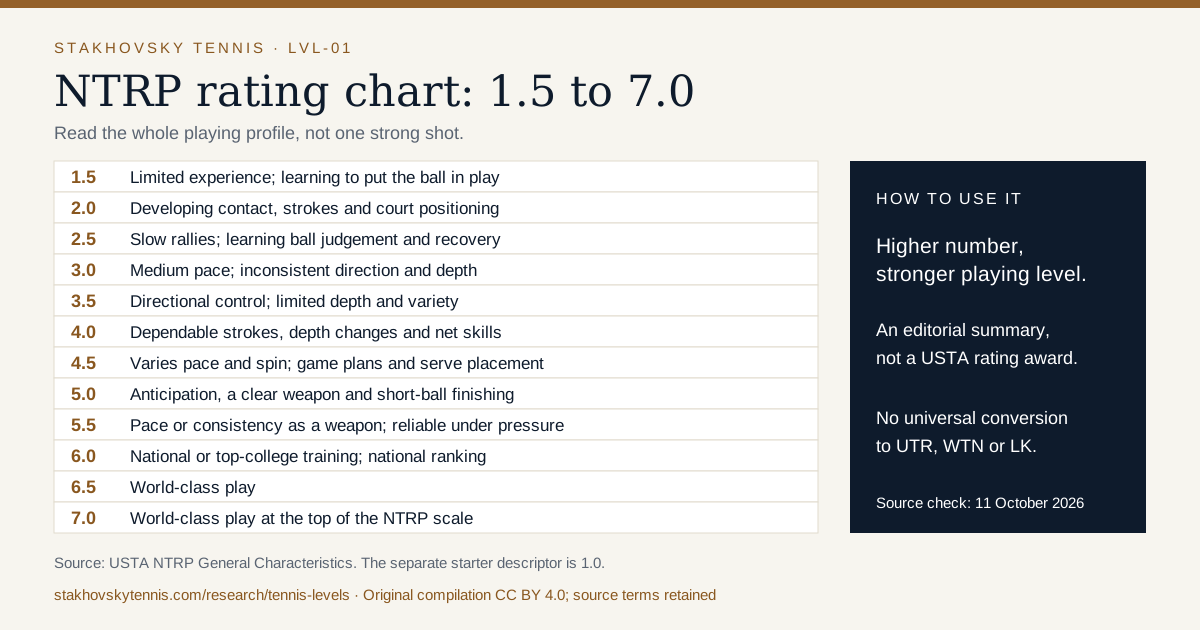
You can also select and copy the text manually.
The image links to its source and limitations.
Frequently asked questions
What is NTRP in tennis?
NTRP is the USTA's National Tennis Rating Program. Its adult rating guide runs from 1.5 to 7.0 in half-point steps, with higher numbers indicating stronger playing ability.
What does NTRP stand for?
NTRP stands for National Tennis Rating Program.
What is a 3.0 tennis player?
A 3.0 player can sustain medium-paced play but still struggles to control direction, depth and pace across all strokes.
What is a 3.5 tennis player?
A 3.5 player controls direction at moderate pace, while depth and variety remain less dependable. Net play and doubles teamwork are developing.
What is a 4.0 tennis player?
A 4.0 player has dependable strokes on both sides, can vary depth during moderate play and can use approach shots, volleys, lobs and overheads successfully.
Is tennis level 6 or 7 better?
In NTRP, 7.0 is stronger than 6.0. In WTN and German LK, lower numbers are stronger, so 6 is stronger than 7. Name the system before comparing numbers.
How do I find my tennis rating?
Check your USTA account for NTRP, your UTR Sports profile for UTR, World Tennis Number or your federation account for WTN, tennis.de for German LK, and Ten'Up for the French classement.
How do I get an NTRP rating?
Follow the USTA self-rating process if you have no eligible current rating, then the applicable league rules. A private coach's estimate does not replace the USTA process.
Is there an official NTRP to UTR conversion?
There is no universal one-to-one conversion. USTA Northern California publishes regional event guidance, including UTR 6–8 for men and 4–6 for women at NTRP 4.0; it is not a national equivalence rule.
What tennis level am I?
Use the chart and four-question self-check as an initial discussion aid. The self-check is an unvalidated estimate limited to 2.5–5.5, not a USTA rating. Match results and an on-court assessment provide more context.
Sources
- USTA: NTRP General Characteristics — descriptive chart, undated.
- USTA: Understanding NTRP ratings — adult scale and league context.
- USTA NTRP frequently asked questions — official rating process.
- USTA Northern California: Generation Gap — regional event ranges.
- UTR Sports: algorithm FAQ — scale, eligible results and rating types.
- ITF: How WTN works — scale, confidence and weekly updates.
- DTB: implementation rules for the LK system — sections 2, 6 and 10.
- FFT: fifth-series announcement — published 24 June 2025, effective 1 July 2025.
- FFT: club guide to classement — current monthly process.