For tactical tennis-match analysis, a stable, elevated, centered camera behind the baseline is usually a strong starting position because it preserves court geometry, both players and point patterns. Record in landscape, keep the full singles court visible and check audio, battery and recording permissions before the match. Any filming of juniors at ITF competitions must follow the tournament's specific authorization process.
A useful match video is not necessarily cinematic. Coaches need to see the serve, return, first four shots, court position and what happened before the final error. A tight portrait clip of a forehand may show the swing but lose all the information that explains why the player arrived late or chose the wrong shot.
This guide by Stakhovsky Tennis explains how to record footage that supports a remote review or a 90-minute in-person performance assessment. The setup is also useful for keeping a consistent archive of tournament and practice matches.
Where should the tennis camera go?
Start from behind one baseline, centered on the singles court and high enough to keep court lines and movement visible. The exact mounting height and distance depend on the venue, fencing and lens. Stability and unobstructed geometry matter more than an arbitrary number of centimeters. Recording guides from video-analysis providers also recommend a stable behind-baseline, elevated, landscape setup. See Kinatra's tennis filming guide.
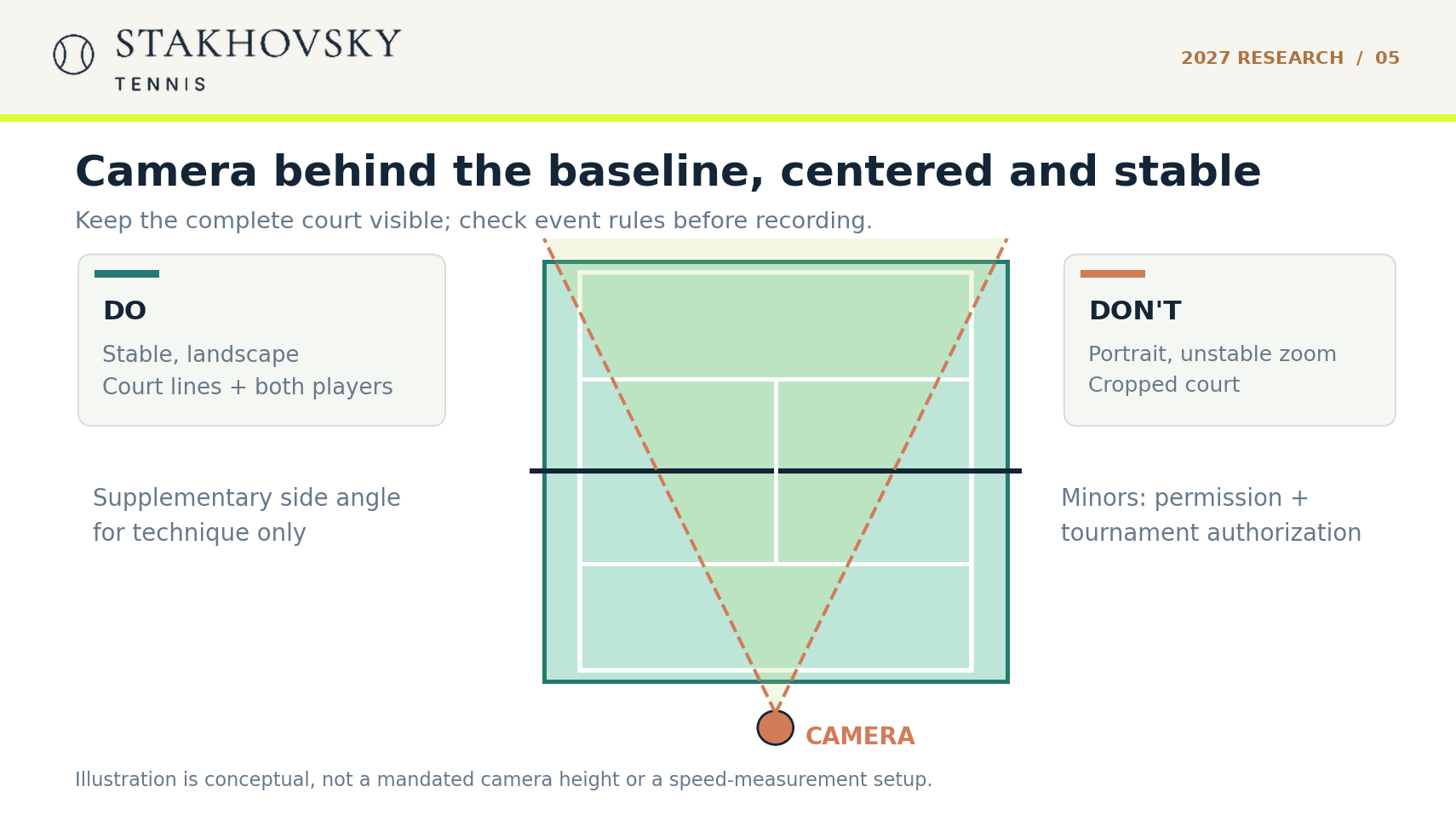
Keep the camera stationary on an authorized fence mount or tripod outside player and spectator circulation. Do not place equipment where it creates a trip hazard, blocks emergency routes or violates club rules. If one player's technique is the only subject, supplementary side-angle footage may help, but use it in addition to the full-court match recording rather than as a replacement.
The pre-match video checklist
| Item | Practical check | Why it matters |
|---|---|---|
| Permission | Ask venue and organizer; obtain required player/guardian permissions | Respect rights and event rules |
| Position | Centered, behind baseline, safely elevated | Court and movement visible |
| Orientation | Landscape | Full-court context |
| Lens/framing | Avoid severe fisheye; include sidelines and baselines | More reliable geometry |
| Stability | Secure tripod or approved mount | Less unusable motion blur |
| Storage | Enough local memory and battery; test clip | Avoid missing the second set |
| File naming | Date, format, player reference, surface, set | Easier review without exposing personal data |
Test one full rally and one serve before play starts. Can you see the far player's position? Is the near server visible during contact? Does the image stay bright enough when the ball crosses a shadow? Can the coach find the start of a point without fast-forwarding through minutes of irrelevant video?
A full match is better than a highlight reel
Highlight clips tend to preserve winners and memorable errors, which can produce selection bias. A coach may need five ordinary neutral points to explain a single spectacular mistake. Whenever allowed, record the match continuously and provide the score, surface, approximate rating context and the main question. If only selected clips exist, disclose that the review is not a comprehensive match audit.
For structured review, provide three short samples with timestamps: a typical service game, a typical return game and one pressure situation. Include the full original when permitted. The Stakhovsky Tennis match-analysis scorecard shows how repeated patterns become priorities; a clip should support a decision, not simply demonstrate a fault.
How to film a forehand or serve for technique review
Match video and technical video answer different questions. For stroke mechanics, an additional side or rear-quarter view can reveal contact spacing and movement sequencing, subject to safe positioning and coach direction. Record a small set of comparable repetitions with a visible target and enough lead-in to show footwork, not just the contact frame. If the goal is ball-speed comparison, standard camera video should not be marketed as validated radar measurement.
Junior filming rules: the most important exception
Filming minors at sanctioned tournaments is not a casual “any parent can record” situation. The ITF's August 2025 procedure for under-18 performance-analysis video at ITF competitions requires written permission from the initiating player's parent or guardian and the opponent's parent or guardian, with the relevant form authorized by the tournament supervisor before recording. The guidance also requires the supervisor to authorize the recording, makes the recording available to the opponent/guardian, allows withdrawal of consent, restricts online sharing and calls for secure retention and deletion when no longer needed. Check the current event regulations because rules can change.
These specific ITF competition procedures should not be assumed to apply verbatim to every local club or Tennis Europe tournament. Venue policy, event rules, privacy law and the rights of other participants still matter. The Czech Data Protection Authority distinguishes questions of taking and publishing identifiable images; recording for a limited coaching purpose does not create unrestricted publication rights.
Safeguarding rule: Share a junior's match footage, name, school or identifying details only with appropriate authorization. Store files securely, limit access and establish a deletion schedule. If consent is withdrawn or an event official refuses recording, stop.
What one useful coaching submission contains
A good submission is more than a link: include the date, court surface, match format, competition level, camera angle and score context. If you are asking about second-serve vulnerability, mark the timestamps of three representative second-serve points, including one point the player won. Do not cherry-pick only failures. For identifiable minors, never use a public/unlisted video link as a substitute for the specific authorization required to record and share the match. Confirm secure access and retention with the coach first.
How to send match video to a remote coach
- Confirm that filming and sharing for analysis are permitted.
- Keep the original high-quality file and avoid unnecessary editing.
- Provide a private-access link through an agreed secure channel rather than posting publicly.
- Note the match date, surface, scoring format, playing context and file length.
- Write a one-sentence question: “Why do I lose control of neutral forehands after a wide backhand?”
- Provide timestamps for two or three examples, but make the broader match accessible if permitted.
- Ask how your coach will handle access and retention, especially for junior footage.
The remote video-analysis programme describes remote match-video review and written priorities. Confirm the current scope and fee before submitting any footage.
Frequently asked questions
What is the best phone camera angle for tennis?
For match tactics, choose a stable, elevated, centered behind-baseline position with the whole court visible. Supplementary side views can be useful for technical questions, but usually lose rally geometry.
Do I need 4K or a high frame rate?
Clear, stable video is more useful than a high-resolution file that misses half the court. Higher frame rates may help with some technique questions; they do not automatically provide accurate ball-speed measurements.
Can I record a junior match at an ITF event?
Only according to current event and ITF rules. The ITF's published 2025 process requires guardian consents and supervisor authorization for under-18 performance-analysis recordings. Check the latest procedure with the tournament supervisor before filming.
Can a remote coach measure UTR from video?
No. Official UTR is calculated from eligible match results according to the rating provider's rules, not awarded by a coach from a video. A coach can assess performance constraints and the quality of competitive decisions.
Method and safety note
Editorial filming guidance, checked 25 October 2026. Camera advice is practical and venue dependent. This article is not legal advice, and local rules may require additional permissions. The ITF document specifically concerns ITF competitions involving players under 18. Sources: ITF safeguarding video procedure, Czech privacy authority, Kinatra filming guide.
About this guide and editorial review
This page is published by Stakhovsky Tennis, a Prague-based coaching practice led by Leonard Stakhovsky. It combines practical coaching interpretation with explicitly attributed third-party research. The service links are commercial information and are not evidence that Stakhovsky Tennis independently validated the cited studies. Editorial source review: 25 October 2026.