A useful junior tennis progress report measures whether the player is becoming more capable, not just whether they won last weekend. Record technical execution under game conditions, tactical decisions, competition behaviors, recovery and player ownership. Use consistent definitions and review trends across several weeks; a single rating or match result cannot tell the whole story.
Junior tennis often produces two opposite mistakes. One family judges every week by wins, rankings and UTR. Another measures progress only by hours on court and whether the player felt a session went well. Both views miss information a coach needs: what improved, what broke under pressure, and whether training is sustainable.
This parent-and-coach scorecard from Stakhovsky Tennis is a structured conversation tool. It does not claim to be a validated psychometric scale or replace a physician, physiotherapist, teacher or safeguarding professional. It is particularly relevant to families considering the Stakhovsky Tennis junior academy in Prague, where player evaluation informs a prioritized development plan.
Five development areas to review together
| Domain | What to record | Example of a useful question |
|---|---|---|
| Technique in context | Contact and placement after movement; serve under score | Can the player repeat the pattern in live points? |
| Tactics and decisions | Neutral vs attack choices; depth; return intention | Does the player choose appropriately before the miss? |
| Competition behavior | Routine, recovery after errors, plan changes | Can the player reset for the next point? |
| Training and recovery | Session exposure, sleep concerns, pain flags, rest | Is the load manageable and appropriate? |
| Player ownership | Goals, feedback and self-review | Can the player explain the next training priority? |
A scorecard is most useful when every observation has context. “Forehand: 3/5” is not actionable. “In 18 random-feed points, forehand attack choices were appropriate in 12 observed situations” is closer to a meaningful note, though it still depends on clear scoring rules and should not be generalized beyond the sample.
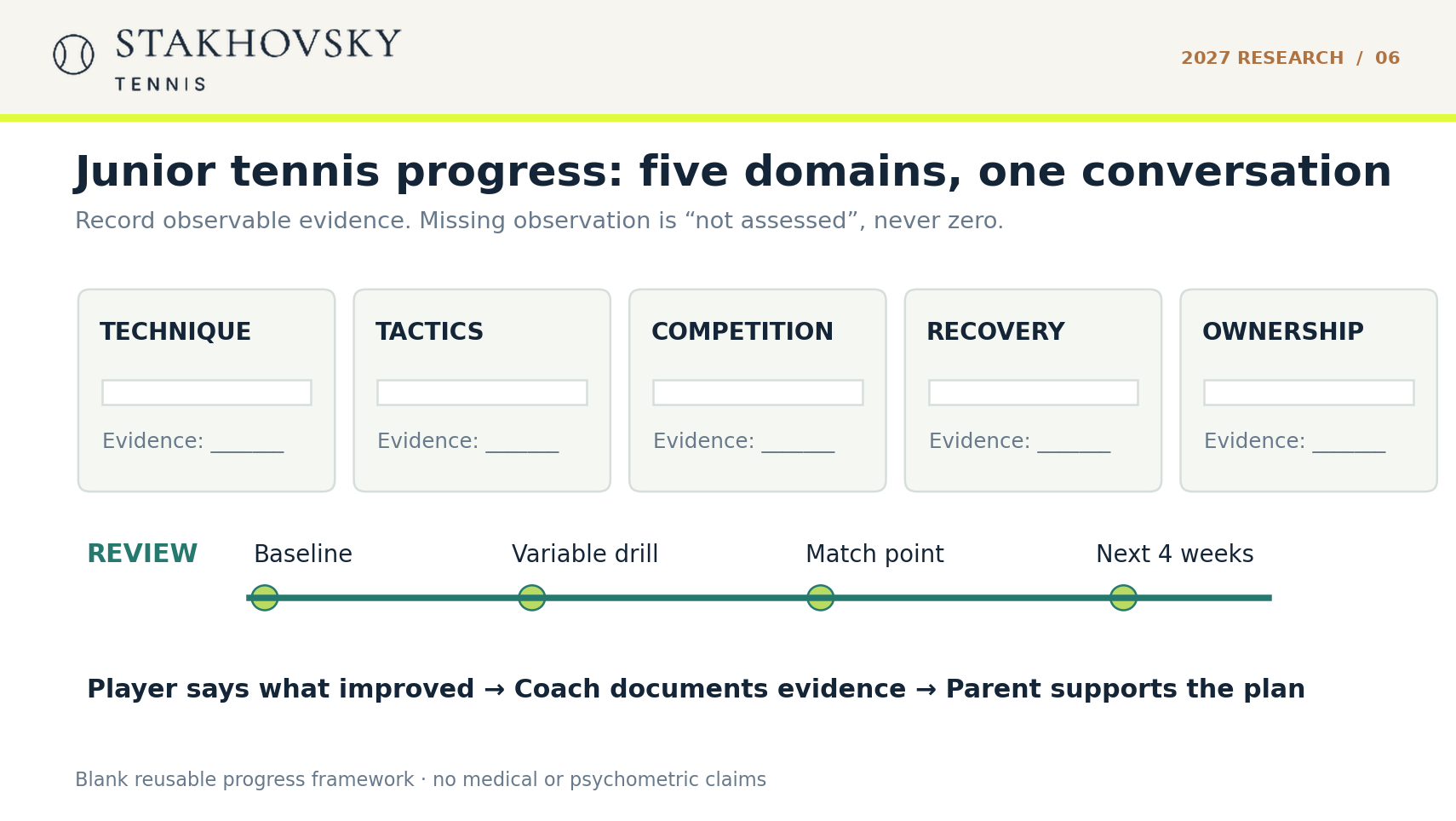
Free weekly progress-report template
Use the same headings every week. Enter “not assessed” rather than zero when a domain was not observed. For younger athletes, prioritize simple words and encourage their own reflections before adults fill in the sheet.
| Week / field | Entry |
|---|---|
| Week beginning | [date] |
| Player goal in their own words | [one sentence] |
| Current competition context | [event, surface and opponent level, if appropriate] |
| One technical priority | [specific, observable task] |
| One decision priority | [when to defend/build/attack] |
| Match evidence | [2-3 timestamps, counts or observed points] |
| Recovery and wellbeing | [player-led comment; escalate concerns appropriately] |
| Coach's next task | [one repeatable practice progression] |
| Player's next commitment | [one agreed action] |
| Parent's support role | [travel, schedule, recovery, communication] |
| Next review date | [date] |
Use the blank downloadable CSV version to record weekly observations. It contains no fictional player profile or presented-as-real progress scores.
Download the blank junior progress scorecard
How to use the scorecard without over-scoring a child
Select one observable measure per domain, then classify it as observed with evidence, observed but inconsistent, or not assessed. The last category is not a zero. Write one piece of evidence from points or matches instead of asking a parent to judge stroke mechanics. A junior could record their own description of a strong decision and one difficult moment. Parents can support sleep, logistics and follow-through without turning every car ride home into a performance review.
Store the template without unnecessary health information or a child's identifying details. If any coach collects medical or psychological data, that requires a separate qualified process and appropriate safeguards.
A better four-week review process
Week 1: establish a baseline. Review one recent match or a representative point set. Identify the top technical and tactical constraints. Save video clips or observer notes with permission and clear file names. Agree on a small number of goals.
Week 2: check execution in variable training. Verify whether the new skill survives changes in ball depth, pace and direction. Do not judge success only from a basket drill where the player knows the next ball.
Week 3: inspect competition decisions. Compare one or two match situations with Week 1. Did the player create a better neutral rally? Did they choose the intended return pattern? What still collapsed under pressure?
Week 4: decide whether to continue, change or pause. Review results and wellness together. If the player reports pain, persistent fatigue, distress or loss of enjoyment, the appropriate action may be rest or professional assessment, not more training hours. The IOC consensus on youth athletic development supports individualized progression, varied development and recovery.
Why rankings and match wins belong in context
Rankings and ratings are important competitive evidence, but they are affected by the quality, timing and number of matches. The Stakhovsky Tennis UTR guide describes why ratings can change as match histories change, and why a rating should not be treated as a skill-by-skill diagnosis. A junior may face stronger competition while improving a particular pattern; the short-term win-loss record can look worse before a fuller development picture becomes visible.
Parents should avoid turning every session into an interview about results. Ask the player first, “What did you learn about the next point?” rather than immediately “Why did you lose?” This is practical coaching guidance, not a claim that a particular question has been proven to improve ranking outcomes.
Track load and health without pretending to diagnose
A log can note total sessions, perceived difficulty, travel days and rest. Do not convert it into a medical screening tool. A sport-specific review on early specialization in junior tennis warns against excessive training and tournament loads, but its guidance is based on a clinical review with evidence-quality limits and should not be converted into a universal prescription for every athlete. Junior tennis specialization review. Individual concerns should be assessed by appropriately qualified clinicians.
Data and privacy: Progress reports for juniors can contain sensitive personal observations. Limit access, obtain appropriate parental/guardian permissions, avoid posting identifiable player data and apply clear retention rules. Match video at ITF competitions has additional permission requirements described in the ITF's under-18 recording process.
How Stakhovsky Tennis uses a performance-first approach
The coaching methodology describes a 90-minute diagnosis, a written plan and follow-up measurement. The player results archive distinguishes first-party measurements from qualitative coaching observations and notes where a result has not been independently audited. Those standards are more useful than claiming an isolated victory proves a complete development transformation.
When a private assessment is worth considering
A private assessment is most valuable when several stakeholders disagree about what limits the player: coach, parent and player. Rather than hiring more general court hours, ask for an external view that identifies observable gaps, evaluates performance in points and translates findings into a manageable plan. Stakhovsky Tennis junior development is positioned for serious competitive players, not as general child care or a guaranteed pathway to professional tennis.
Frequently asked questions
How often should a junior tennis progress report be completed?
A short weekly log and a fuller review every four weeks is a practical editorial suggestion, not an evidence-based mandatory frequency. Adjust to the player, competition schedule and coach's actual observation opportunities.
Should parents rate their child's technique?
Parents can help record attendance, questions and the player's reflection. Technical ratings should be explained and anchored to observable video or coach-defined criteria rather than a parent's impression after one match.
Is a UTR improvement the best measure of progress?
It is one useful outcome, not the only one. Track tactical decisions, movement, recovery and skill execution separately so a rating change does not erase genuine development work or conceal a problem.
Does this report diagnose burnout or injury?
No. The wellness entries are prompts to notice concerns and seek support. They do not diagnose injury, burnout, anxiety or any medical condition.
Method and disclosure
This is a Stakhovsky Tennis editorial framework prepared in October 2026, not a validated developmental instrument. The blank template has no player data. The academy is a commercial coaching practice. See IOC youth development consensus and sports-specific tennis training review. For data-use questions, refer to relevant event rules and privacy guidance.
About this guide and editorial review
This page is published by Stakhovsky Tennis, a Prague-based coaching practice led by Leonard Stakhovsky. It combines practical coaching interpretation with explicitly attributed third-party research. The service links are commercial information and are not evidence that Stakhovsky Tennis independently validated the cited studies. Editorial source review: 25 October 2026.