A useful tennis match analysis starts with a precise question: why did this player lose points they could realistically have won? Record serve, return, rally length, error type and the match situation. Compare repeated patterns rather than reacting to a few memorable points. Then design one practice task that reproduces the original match constraint.
A match result tells you who won. It rarely tells you what to work on Monday. A player can lose 6-3, 6-3 because of second-serve weakness, because they cannot defend the backhand corner, or because they rush neutral balls when the score becomes uncomfortable. Those problems require different practice. This guide from Stakhovsky Tennis turns a match into a short, testable coaching plan. It is designed for competitive adults, juniors, parents and local coaches who want to make decisions from evidence rather than guesswork.
Use the scorecard below or download its blank CSV version to record a match. The template is not a substitute for official umpiring records and is not a validated performance test.
Which tennis statistics actually help a coach?
Start with five groups: serve, return, rally, decisions and context. Keep the first version small enough for one observer to record reliably. According to the LTA's tennis-statistics glossary, first-serve percentage and points won on first and second serve answer different questions. A player may put in many first serves without winning many of those points. Similarly, the percentage of return points won is not the same as the number of returns put in play.
| Metric | Calculation | Useful coaching question |
|---|---|---|
| First serves in | First serves landed / service points | Is the first delivery reliable enough? |
| First-serve points won | Points won after a made first serve / points with first serve in | Does the first serve create an advantage? |
| Second-serve points won | Points won after first-serve faults / points with first-serve fault | Is the second delivery vulnerable? |
| Return points won | Return points won / return points played | Is the return neutralizing the opponent? |
| Double faults | Count of lost service points caused by two faults | What happens under serve pressure? |
| Short-rally points lost | Lost points ending in the first four shots / tagged short-rally points | Are serve-plus-one and return-plus-one failing? |
Important denominator rule: calculate percentages only for points actually classified. A camera angle that hides the baseline or a match with missing points should have an explicit coverage note. Do not assign hidden or uncertain shots to a category. Professional-match research analyzing 4,669 points across Grand Slam surfaces found that 65%-77% of points ended within one to four shots in its defined sample; that is context for elite men's singles, not a benchmark to impose on a club player. Read the study.
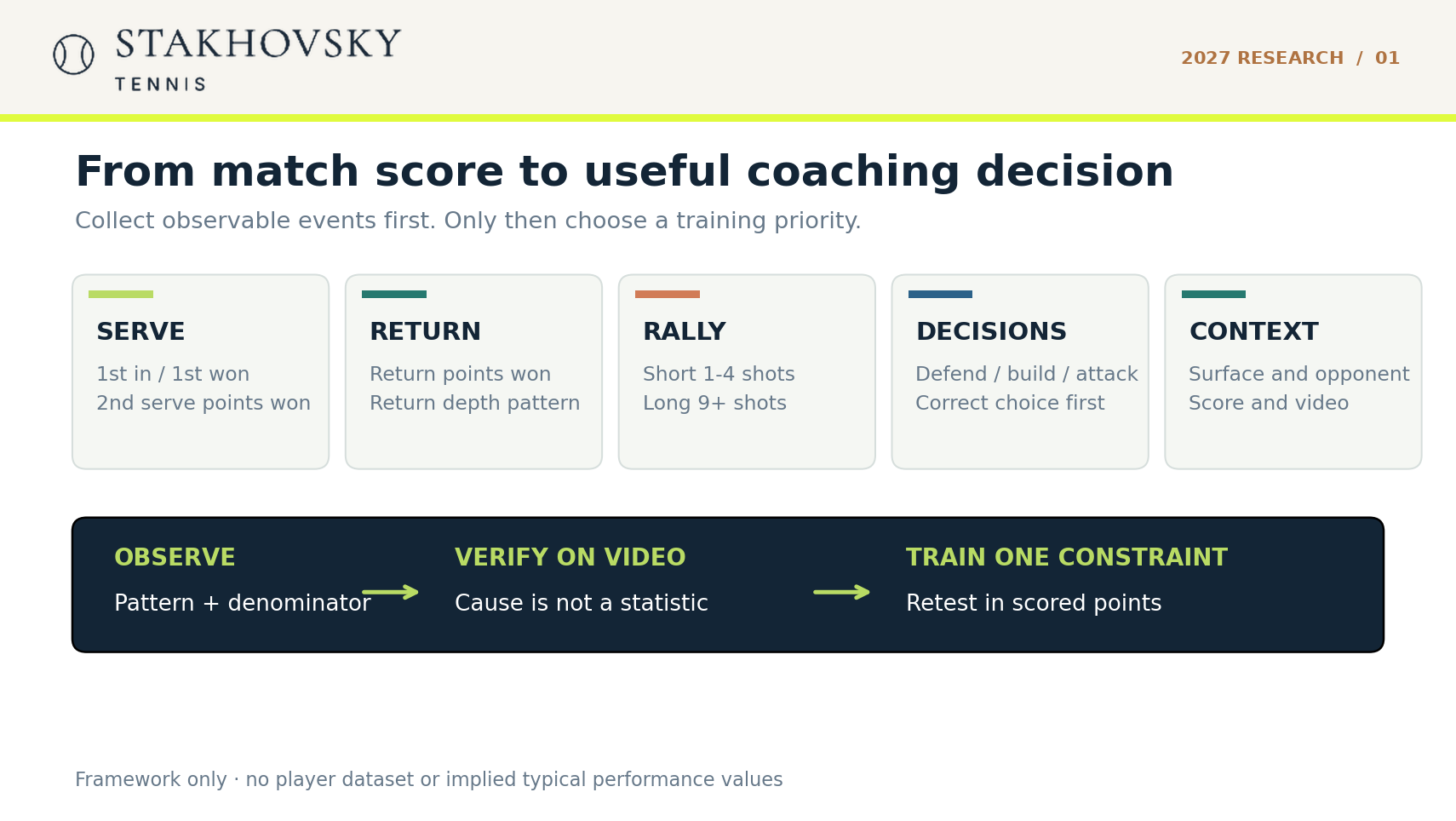
Free match-analysis scorecard: the fields to record
For each point, capture set, game score, server, first serve in (yes/no), second serve outcome if applicable, point winner, rally-length band (1-4, 5-8, 9+), terminal shot and a short reason. Tag the last shot only when you can observe it. Possible reasons include double fault, clear forced error, clear unforced error, winner or unclear. Classifying a forced versus unforced error involves judgment; two observers may disagree. Be consistent and document your rule.
| Point field | Example of permitted input | Why it matters |
|---|---|---|
| Point number | 001 | Maintains an auditable match sequence |
| Server | Player A / Player B | Separates service and return performance |
| First serve in | Yes / No / Unknown | Denominator for first-serve percentage |
| Outcome | Won / Lost / Unknown | Supports points-won measures |
| Rally length | 1-4 / 5-8 / 9+ / Unknown | Distinguishes early and extended rallies |
| Terminal pattern | Serve+1 / Return+1 / Neutral / Defence / Unknown | Links stats to training |
| Pressure flag | Break point / Game point / Tiebreak / Normal | Tests a specific hypothesis |
| Video timestamp | hh:mm:ss | Lets a coach recheck the decision |
The downloadable blank CSV contains no player results.
Download the blank match-analysis files
If match footage is incomplete, write “unknown” rather than forcing a statistic. Keep the raw point log, not just the summary percentages. It lets a second reviewer reproduce or challenge your calculations.
A practical five-step match-analysis workflow
Step 1: choose one hypothesis before watching
Do not start by counting every winner. Ask a question such as “Do I lose the point because my second serve sits short?” or “Do I attack neutral forehands before creating court position?” A hypothesis gives the analysis a decision. If the film does not support it, discard it and examine another pattern.
Step 2: collect context before interpreting numbers
Record court surface, ball type if known, playing level or rating source, opponent style, scoring format and whether the match was part of a tournament or practice. Performance against a stronger opponent can change error rates even when the player's technique is unchanged. A match filmed from a poor angle may not support ball-depth or line-call judgments.
Step 3: review five to ten representative points in each problem category
Move from counts to examples. For a second-serve problem, review the delivery, opponent's return, recovery position and the first groundstroke. For a missed short-ball attack, review the ball recognition, spacing, footwork and choice of target. A missed forehand can be a decision problem rather than a forehand-mechanics problem.
Step 4: rank constraints, not isolated mistakes
Prioritize the problem that is frequent, has a large influence on lost points and can realistically be changed. A useful working model is impact × recurrence × trainability, scored qualitatively by the coach. It is a decision aid, not a scientific index. If a player misses one spectacular overhead but repeatedly starts second-serve points defensively, the second serve normally gets priority.
Step 5: convert the finding into a one-week experiment
Write a training prescription with three parts: the match pattern, a representative drill and a retest. For example: “When receiving a second serve to the backhand, the player lands a short return; run 30 scored returns with changing depth and direction, then compare return depth and point outcomes in the next set.” The retest must use an observable definition. The Stakhovsky Tennis coaching methodology starts from a 90-minute diagnosis and prioritizes three corrections rather than creating a long list of tips.
Worked calculation: use the right denominator
The following arithmetic is illustrative, not a client result. Suppose you record 60 eligible service points, with 38 first serves in and 22 first-serve faults. The first-serve percentage is 38/60 = 63.3%. If the server wins 23 of the 38 first-serve points, first-serve points won is 23/38 = 60.5%. If the player wins 10 of 22 second-serve points, second-serve points won is 10/22 = 45.5%. The three percentages answer different questions. Do not calculate points-won percentages from all service points when the denominator must be first-serve-in points or first-serve-fault points.
For a useful retest, write down the number of observed points and whether the next opponent, surface and filming coverage were comparable. A 10-percentage-point change over a handful of points may be noise rather than improved execution.
A sample coaching interpretation, not a fabricated match
Imagine that a player's handwritten log shows frequent lost points immediately after a second serve. Without actual counts, we cannot conclude the serve is the cause. The coach should inspect whether returns are aggressive, whether the second serve lacks placement, and whether the player recovers too slowly. One causal explanation may be supported; another may not. The correct next step is a repeatable court test, followed by match verification. Never present a hypothetical diagnosis as a measured Stakhovsky Tennis client outcome.
What this template cannot tell you
A single match is not a stable skill rating. Winner and unforced-error definitions are observer dependent. Short rallies are not automatically bad; their meaning depends on who initiated the point. Professional benchmarks may be inappropriate for juniors, recreational players or different surfaces. Video analytics can support classification, but automation should not replace review of questionable events. If you need official score or rules definitions, consult the ITF tennis glossary.
When to ask a coach for a match-performance audit
Bring one full match, your point log if available, your rating or competitive context, and a single decision you want answered. Stakhovsky Tennis offers on-court coaching in Prague and remote video-based performance review through its remote video-analysis programme. The objective is a short, prioritized plan, not a claim that software or one match can predict results.
Tennis match analysis FAQs
Should I track winners and unforced errors?
Yes, if you can identify them consistently, but start with serve/return, point outcome and the first four shots. Unforced-error judgments are subjective. A recorded “unknown” is better than a confidently wrong number.
Can I use one match to change my technique?
One match can identify a problem worth testing. Technique changes should be checked in a court assessment and retested in points, because the original miss may involve timing, movement, selection or pressure rather than stroke mechanics.
Does match analysis work without video?
It can. A point-by-point observer can collect a useful minimum log. Video improves the ability to review decisions and reduces reliance on memory, provided filming is authorized.
Where do I find the downloadable template?
Download the free point-by-point CSV and summary sheet from the download panel accompanying this article. Both are blank, reusable worksheets. They are not a substitute for an official match record.
Method and source notes
This is an editorial coaching framework created by Stakhovsky Tennis. It synthesizes governing-body statistic definitions and peer-reviewed notational-analysis research. It does not introduce new population results. The companion table contains blank fields only. Last evidence review: 25 October 2026.
About this guide and editorial review
This page is published by Stakhovsky Tennis, a Prague-based coaching practice led by Leonard Stakhovsky. It combines practical coaching interpretation with explicitly attributed third-party research. The service links are commercial information and are not evidence that Stakhovsky Tennis independently validated the cited studies. Editorial source review: 25 October 2026.