A tennis stroke can look reliable in practice and fail in competition because the player must perceive, move, decide and execute under variable balls and score pressure. A useful fix is to progress from controlled repetition to variable feeds, scored points and match-like constraints, measuring what transfers at each stage.
The problem is common: in practice, your forehand lands deep and your backhand feels calm. In a match, you shorten the swing, rush forward or choose a lower-percentage target. The temptation is to rebuild the stroke. Often that is premature. A match asks for more than ball striking. It asks you to read the ball, recover, choose a response and stay committed when the score matters.
At Stakhovsky Tennis, the starting point is to identify which part of that chain breaks. The 90-minute performance assessment in Prague examines technique, movement and decisions rather than treating every missed shot as proof of poor mechanics.
Five reasons practice performance fails in matches
1. The drill makes the next ball predictable
A basket feed to the same contact point reduces uncertainty. That can be useful to learn a movement, but it does not reproduce a rally in which height, pace, direction and spin change. A study comparing common tennis practice tasks with match play found meaningful differences in shot and movement behavior, supporting more representative practice design. Research on representative tennis practice.
What to test: repeat the same forehand goal with random depth and direction. If success falls sharply once the ball becomes variable, prioritize reading and spacing before adding swing speed.
2. The player arrives late or too close to the ball
A good-looking stationary shot can disappear after a defensive recovery. The error may happen two steps before contact. Watch split-step timing, first movement, distance from the ball and recovery toward a useful court position. Compare missed shots that follow movement with those hit from balanced positions.
What to test: alternate neutral, wide and short balls. Track clean contacts after the first recovery rather than counting only well-struck feeds.
3. The player has not practiced choosing the right shot
Players frequently know how to hit cross-court and down the line, but not when each option makes sense. In a match, court position, incoming ball height and opponent location change the decision. Try a simple traffic-light rule: defend from red, rally with margin from amber, attack a genuinely favorable green ball. This is a coaching heuristic, not a validated classification test.
What to test: have the player announce “defend / build / attack” before hitting. Review incorrect choices, not just the final result.
4. The score changes movement and attention
A player facing break point may rush, over-control a second serve or avoid their best shot. A useful intervention is to practice with consequences and a consistent between-point routine. Evidence on professional tiebreak patterns indicates tactics and outcomes vary by context, but it does not show that one routine cures match anxiety. 2026 Grand Slam tiebreak analysis.
What to test: play short sets starting at 30-30 or 4-4, define a plan before the point and review whether the decision stayed consistent. If anxiety is persistent or severe, discuss support with a qualified sport psychologist rather than labeling every issue a mindset failure.
5. The practice target rewards the wrong result
If success is counted only as balls landing in, the player may win the drill by pushing safe shots that never challenge an opponent. If it counts only maximum speed, the player may spray errors. Define a target that connects to competition: depth, margin, shot selection, recovery and point outcome.
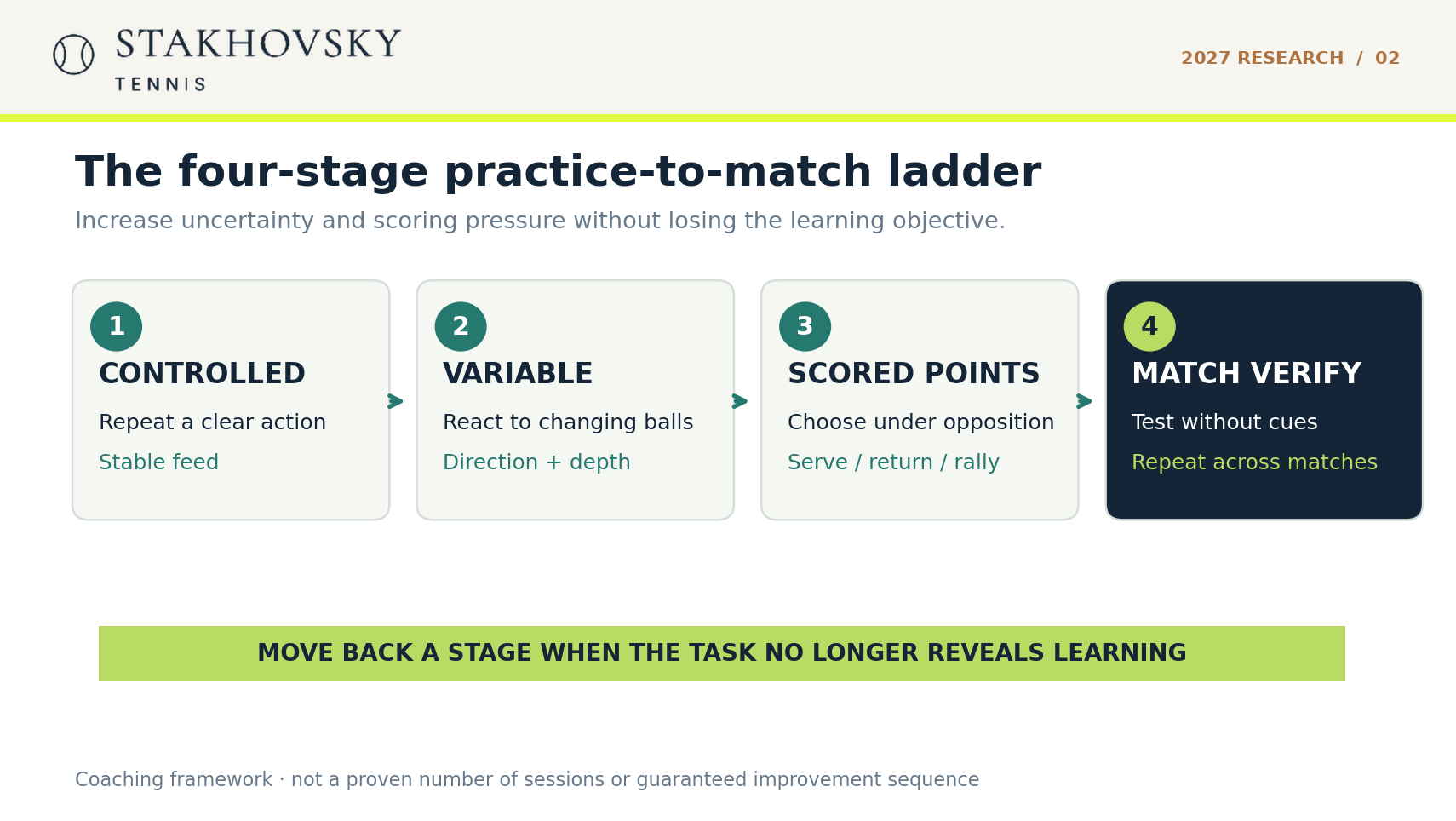
The four-stage practice-to-match transfer plan
| Stage | Constraint | Measure | Move forward when |
|---|---|---|---|
| Controlled technique | Stable feed and clear contact target | Contact quality and placement | The basic action is repeatable |
| Variable practice | Randomized depth, direction and pace | Success after movement | Quality survives uncertainty |
| Scored points | Opponent, score and tactical choice | Correct decisions and point patterns | The player chooses effectively |
| Match verification | Real scoring and match context | Same metrics in competition | Gains persist outside the drill |
A player may need to move backward in this ladder when the new task becomes too difficult. That is normal. The goal is not to make each session look impressive; it is to make the solution survive progressively more realistic conditions. A 2026 methods paper discusses how representative learning design can use competition data to inform practice constraints, but its analytical possibilities should not be confused with a proven recipe for every player. Teune, Singh and Robertson.
A three-metric transfer scorecard
Choose only measures that represent the original match problem. A forehand-spacing project might track (1) balanced contacts after movement, (2) correct defend/build/attack decisions, and (3) the proportion of target balls that land with usable depth. Define the observation rule before training. Record the same measures in a variable drill, a scored point exercise and the next competitive set. Better scores on only the predictable drill are evidence of practice performance, not evidence of match transfer.
Ask the player to explain the point decision before the coach gives feedback. This prevents the review from becoming a collection of technique corrections without a tactical explanation.
A one-week test for an adult player
Session 1: diagnose. Film ten minutes of predictable rally feeds and ten minutes of unscripted points. Record one recurring miss and what preceded it. Do not change five things simultaneously.
Session 2: vary. Practice the same stroke with changing ball depth or direction. Keep a sufficient contact margin. Record the number of playable balls reached and the number returned to a useful target.
Session 3: add decision pressure. Begin points with a defined situation, such as second serve to the backhand. Score a point only when the chosen pattern is both reasonable and executable.
Session 4: verify. Play a set without coaching cues. Recount the original pattern and compare it to Session 1. If the pattern persists, rewrite the hypothesis. A short week may uncover a useful correction, but it cannot establish durable improvement.
Real cases require honest interpretation
The published Cinar Prague performance-block case reports improvements in serve and forehand speed and coach-observed progress in match behaviors. The match transfer component is qualitative, without disclosed match scores; it is not a controlled proof that the speed changes caused wins. That distinction matters when a coach evaluates whether a practice gain really transfers.
Should you change your forehand or your decisions first?
Begin with a simple sequence: did you read the incoming ball; did you arrive in good space; did you choose a plausible target; and did you execute the intended stroke? Repeated failures on the same technical pattern despite good spacing justify technical work. If the stroke performs in variable drills but fails on pressure points, investigate attention, tactics and score-specific behavior first.
For a private training context, see adult tennis coaching in Prague. Parents of competitive juniors should review the junior development program, which integrates technical work with point play and match preparation.
Frequently asked questions
Why do I tense up during tennis matches?
Possible contributors include score pressure, fear of mistakes, unreliable between-point routines and unfamiliar tactical decisions. The correct explanation depends on the player. Use video and point-pattern evidence before assuming a purely psychological cause.
Is more repetition the solution?
Sometimes. Repetition may establish a technical movement, but predictable repetition alone does not prepare players for the variability of competition. Progress to representative points and matches once the action is sufficiently stable.
How many matches do I need to assess transfer?
There is no universal minimum. Start with one comparable match as a check, then observe the pattern across further matches and opponents. One set or one weekend is not proof of a durable skill gain.
Can junior players use this approach?
Yes, with age-appropriate constraints, sensible training loads, adequate recovery and attention to player enjoyment. The IOC youth-development consensus emphasizes individualized development and health rather than chasing volume alone.
Research and editorial method
This is a practice-design interpretation based on peer-reviewed research and Stakhovsky Tennis's declared methodology. It is not a randomized evaluation of the academy's coaching model. Editorial research verified 25 October 2026. Sources: representative tennis practice, 2026 learning-design methods, IOC youth athletic development.
About this guide and editorial review
This page is published by Stakhovsky Tennis, a Prague-based coaching practice led by Leonard Stakhovsky. It combines practical coaching interpretation with explicitly attributed third-party research. The service links are commercial information and are not evidence that Stakhovsky Tennis independently validated the cited studies. Editorial source review: 25 October 2026.