There is no defensible single “average forehand speed” that applies to adults, juniors, club players and professionals under all conditions. Published studies measure different populations, target directions, ball feeds, speed devices and definitions of accuracy. The Stakhovsky Tennis 2027 index is therefore a source-labelled evidence guide and test protocol, not a fabricated leaderboard of players or age groups.
A fast forehand is useful only when it gives the player an advantage without unacceptable error. That sounds obvious, but many online forehand-speed lists omit the information needed to compare numbers. Was the ball fed slowly or hit in a rally? Was the shot cross-court? Was speed measured at impact or later in flight? Were missed balls excluded? Did the player have to move?
Stakhovsky Tennis publishes this source-led reference to make those questions visible. Readers looking for an individual diagnosis can begin with the Prague performance assessment; a population table cannot identify why one player struggles with timing or court position.
What the research actually establishes
A peer-reviewed study by Landlinger and colleagues compared six elite and seven high-performance players and analyzed 1,040 groundstrokes using a Doppler radar device and high-frame-rate video. Elite players generally struck the ball faster under the tested conditions; the work also evaluated accuracy for cross-court and down-the-line targets. The small groups and defined tasks make this useful mechanistic evidence, not a universal consumer speed chart. Study DOI.
A separate study involving 85 young male competitive players examined forehand, backhand and serve speed in defined tests. Ball speed rose with competitive level in that sample while accuracy did not consistently distinguish the groups. The participants and protocol matter: the paper cannot be applied directly to all adult or female players. Read the study.
A third approach, the ForeGround protocol, measured velocity, placement precision and success rate in more realistic programmed rallies among young low- to intermediate-level players. It shows why an integrated measure can be more informative than a single speed maximum. ForeGround validation abstract.
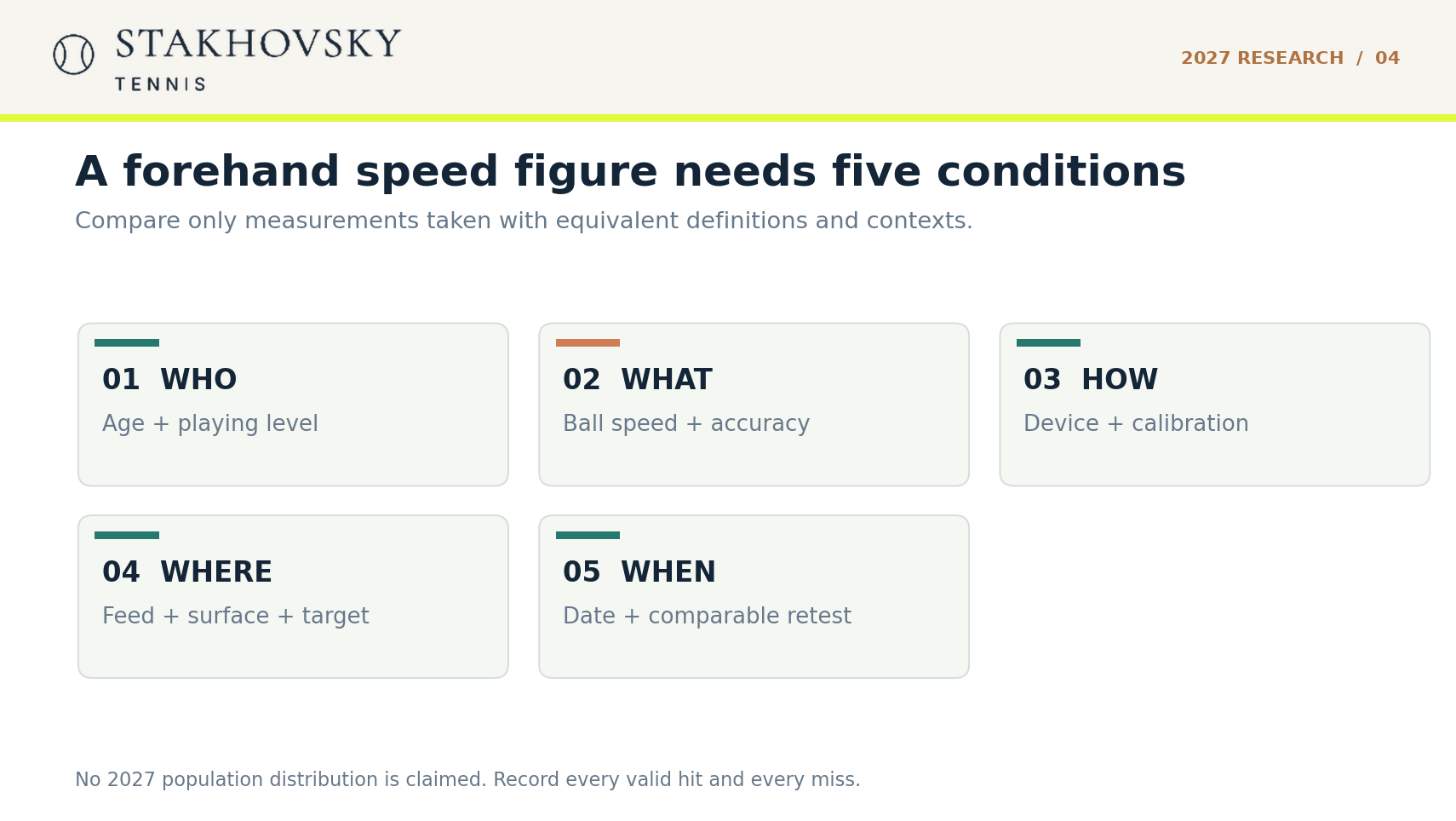
The five measures that belong in a useful forehand test
| Measure | Definition to publish | Frequent mistake |
|---|---|---|
| Average ball speed | Arithmetic mean of valid measured strikes in a defined set | Excluding difficult balls without disclosure |
| Maximum ball speed | Highest observed speed in the set | Presenting one shot as normal playing level |
| In-court rate | In-court balls / all attempted balls | Ignoring errors when speed rises |
| Target success | Shots reaching a fixed landing zone / all attempts | Changing target size between tests |
| Test context | Feed, movement, side, surface, ball, device and date | Comparing unlike drills as if identical |
Download the blank forehand testing log
The index should report mean and maximum separately. For any study used as a benchmark, record sample size, age/level, stroke direction and exact measurement technique. Convert mph to km/h only after recording the original unit; the conversion is 1 mph = 1.609344 km/h.
A reproducible forehand measurement protocol for clubs
Define the population and stroke
Record the player's age band, competitive experience, side (forehand), target direction (cross-court or down the line) and the court surface. Avoid publishing identifying information about junior players without the relevant permissions. A player who hits 20 fed forehands is not being tested in the same task as a player running wide during live points.
Keep the test equipment and feed as consistent as possible
Use the same radar or validated measuring setup, measurement location, ball type, court and feed parameters for baseline and retest. Record calibration limits if supplied by the manufacturer. High-speed camera estimates are not directly interchangeable with radar results without validation. A 2026 methods study compared a specialist high-speed video system against radar in 178 recorded strokes; that does not validate arbitrary consumer-phone speed readings. 2026 methods study.
Record every attempt, including misses and missing measurements
For each ball, store trial number, speed if measurable, whether the ball landed in, whether it hit the target area and whether the feed met the planned condition. If a speed is unavailable, record it as missing; do not enter zero. For summary speed, describe whether the average covers all measured strokes or only those that landed in. Reporting both can be informative if the sample supports it.
Retest under the same conditions, then under game constraints
A controlled retest asks whether the measured stroke output changed. A scored point set asks whether the player can use the stroke in a competitive sequence. Those are different outcomes and should remain separate in the data. A coaching decision should consider the second as well as the first.
A documented single-player example, not a normative benchmark
The Aman case study reports average forehand ball speed of 91 km/h at the start and 104 km/h after a six-day intensive; maximum speed changed from 103 to 114 km/h. These numbers are first-party observations from one US adult, without a published device, shot count or independent audit. They belong in an examples section, not in a table called “average speed of adult players.” The one-week improvement guide explains the case boundary.
Example reporting record: one session, no invented norm
A publishable row should specify: player cohort, number of balls attempted, number measured, number in, median and mean ball speed (if valid), directional target, proportion landing in the target, device, feed method, and date. The downloadable log is blank because Stakhovsky Tennis has not published a representative 2027 population sample. Do not derive categories such as “advanced players average X km/h” from the single Aman case. Separate player-level changes from between-player rankings.
The 2027 source-register format
| Source / observation | Population | Measure | Transferability |
|---|---|---|---|
| Landlinger et al. (published 2011) | 6 elite + 7 high-performance players | Speed and target accuracy; 1,040 shots | Narrow elite/high-performance test population |
| Young-player reliability study (2018) | 85 young male competitors | Speed and accuracy under a specified court test | Not a norm for all adults or juniors |
| ForeGround study (2004) | Young low/intermediate players | Velocity + placement + success | Different test and development stage |
| Stakhovsky Tennis Aman case (2026) | One competitive adult | Before/after average and maximum speed | Individual practice observation only |
Publication note: “Index” means a curated, version-controlled register of published observations and protocols. It does not indicate that Stakhovsky Tennis has measured a representative 2027 population. If new first-party measurements are collected later, publish the denominator, instrument, inclusion criteria, distribution, uncertainty and consent status before adding normative charts.
What should players try to improve first?
Avoid chasing a number without knowing how points are lost. If the forehand breaks down only after moving wide, test footwork and spacing. If a player reaches the ball well but chooses the wrong attacking target, use decision drills. If a controlled groundstroke is slow, examine whether faster acceleration can occur without losing reasonable in-court and target success. The Stakhovsky Tennis methodology places the decision inside a structured assessment rather than applying one speed threshold to every player.
Frequently asked questions
What is the average tennis forehand speed in 2027?
No single evidence-backed value covers all playing levels and testing conditions. Different research protocols make universal comparisons misleading. Use a clearly defined population and test procedure when quoting a number.
Is a faster forehand always better?
No. Match value also depends on ball placement, consistency, recovery, shot selection and opponent response. Speed should be evaluated alongside success and game context.
Can I measure forehand speed with a phone?
Video may document strokes and support qualitative review. A phone's speed estimate should not be treated as radar-equivalent unless that system has been validated for the particular camera geometry and method used.
Does a six-day improvement prove a permanent change?
No. It records a before-and-after difference in one disclosed block. Retention and match transfer require separate follow-up testing.
Method, limitations and editorial disclosure
Editorial research verified 25 October 2026. This guide is an editorial evidence synthesis published by Stakhovsky Tennis, a commercial tennis-coaching practice. It is not peer-reviewed original research and has no independently audited 2027 dataset. Underlying papers retain their original data and intellectual-property terms. We publish source population and test conditions alongside each cited claim.
About this guide and editorial review
This page is published by Stakhovsky Tennis, a Prague-based coaching practice led by Leonard Stakhovsky. It combines practical coaching interpretation with explicitly attributed third-party research. The service links are commercial information and are not evidence that Stakhovsky Tennis independently validated the cited studies. Editorial source review: 25 October 2026.