A focused week of tennis training can produce measurable changes in a specific task, but the size and durability of improvement depend on the player, method and measurement conditions. In one published Stakhovsky Tennis case, a US adult player's average forehand ball speed increased from 91 to 104 km/h during a six-day Prague training block. This is one first-party case, not an expected result for others or proof of match improvement.
When an adult player travels for a tennis intensive, the useful question is not “Can I become a different player in seven days?” It is “Can we identify the most limiting constraint, work on it intensively, and verify a measurable change?” The answer can be yes for selected technical tasks. But a short block is a poor place for broad promises about rating gains, tournament wins or permanent technique changes.
This article explains the evidence behind a real case from Stakhovsky Tennis in Prague, what the reported measurements mean, and how to design a short visit with sensible outcomes and follow-up work.
The documented case: Aman, six days in Prague
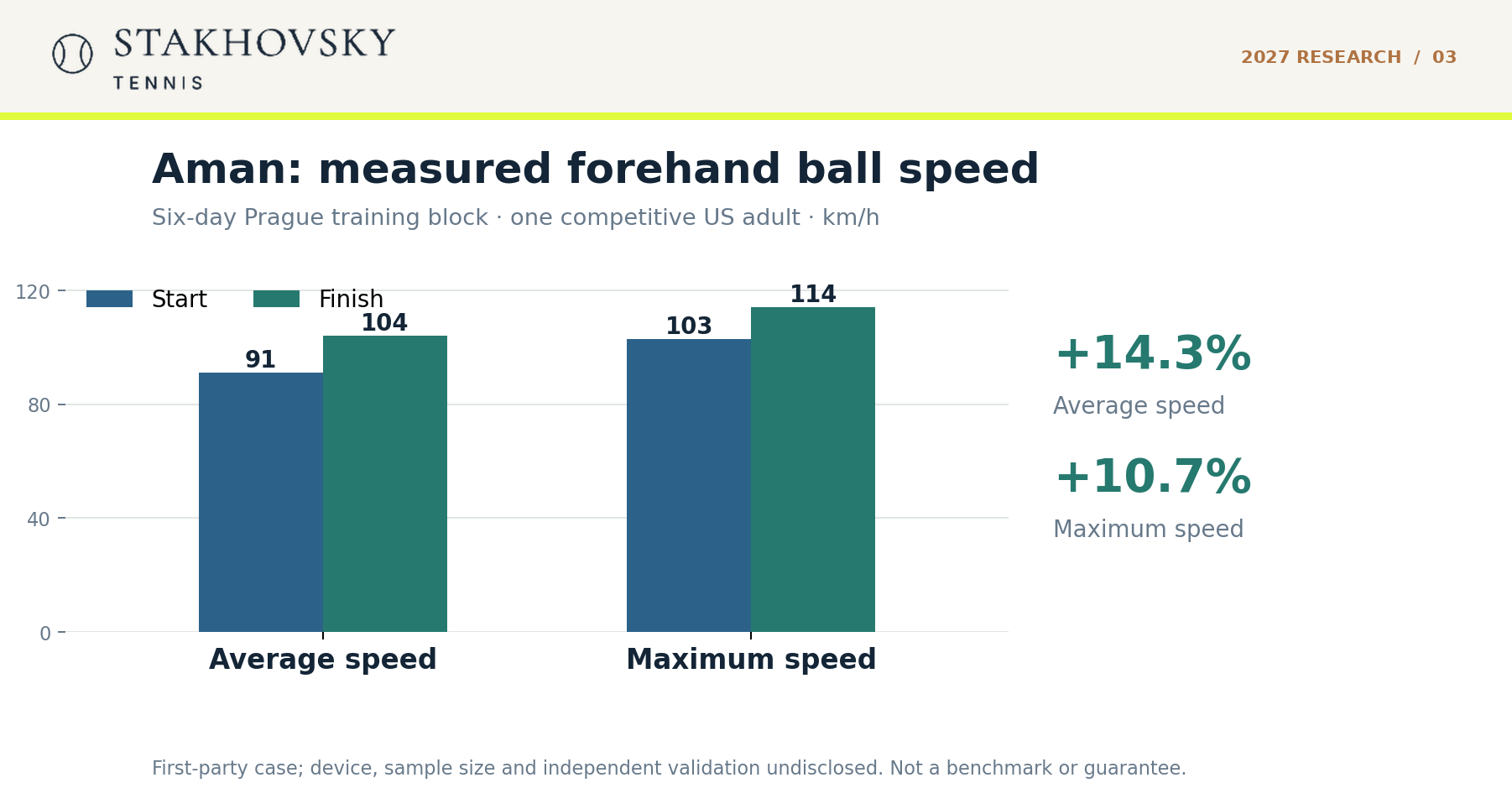
The published Aman training case describes a competitive adult player from the United States who completed a focused six-day forehand block with Leonard Stakhovsky. The site reports the following start and end measures:
| Measurement | Start | Finish | Absolute change | Relative change |
|---|---|---|---|---|
| Average forehand ball speed | 91 km/h | 104 km/h | +13 km/h | +14.3% |
| Maximum forehand ball speed | 103 km/h | 114 km/h | +11 km/h | +10.7% |
These calculations are reproducible: (104 - 91) / 91 × 100 = 14.2857%; (114 - 103) / 103 × 100 = 10.6796%. Results are rounded to one decimal place, matching the original case.
Why average speed is more informative than one fast shot
A maximum tells you the highest recorded value in the observed set; it does not reveal how often the player can reproduce it. A higher average suggests that the recorded sample shifted, but that interpretation depends on a comparable sample and measurement process. The case report does not disclose the device, measured sample size, test protocol, ball type, court surface, exact dates or independent validation. We therefore cannot rule out changes in feed difficulty or recording conditions.
What can be said: the published start and finish numbers differ by 13 km/h on the average metric and 11 km/h on the maximum metric. What cannot be said: that most players gain 14%, that the change would persist six months later, or that it automatically increased Aman's tournament win rate.
What would make this result stronger evidence?
A coach who wants to publish a reproducible before-and-after case should record the ball-speed device and calibration; shot-selection rule; number of valid attempts; treatment of misses; feed, surface and ball conditions; and the timing of the baseline and finish tests. A stronger follow-up includes ball-in percentage, placement distribution and performance in scored points. The published Aman case does not disclose those details, so its recorded speed increase cannot be separated confidently from all testing-condition effects. It is a useful example of a training target, not a population estimate.
What can change during a short intensive?
Technique and contact quality
A player may discover that spacing, sequencing or contact timing blocks an otherwise capable swing. Simplifying one movement or changing the feed can make an immediate difference in a drill. That does not mean the movement is yet automatic when a tired player faces a returner and an unpredictable ball.
Ball speed and placement under a defined test
Speed is one measurable output. A serious test should also record target success, depth, margin and any errors, because a faster ball outside the court has no competitive value. Peer-reviewed ball-speed studies report different protocols and populations. In one study of 85 young male competitive players, researchers used repeated stroke trials and evaluated both speed and accuracy. Read the study.
Match decision-making
One week can clarify a tactical problem: predictable attack direction, a weak return against a second serve, or a recovery pattern that gives up court space. The player can leave with a plan to test in competition. A training block cannot responsibly promise that the plan will change match results immediately.
The ideal six-day training-block structure
| Day | Focus | Evidence to preserve |
|---|---|---|
| Day 1 | Baseline assessment and one prioritized limitation | Initial video and defined test |
| Day 2 | Correct basic movement and contact | Repeatable drill notes |
| Day 3 | Vary feeds and add movement | Success rate with comparable tasks |
| Day 4 | Introduce scoring and opponent decisions | Short-point video and tactical notes |
| Day 5 | Pressure-test against a player or returner | Point-level observations |
| Day 6 | Reassess and write a 30-day continuation plan | Comparable final test and action list |
This is a proposed editorial framework, not a claim about the detailed schedule of Aman's actual program. Real session length and activity depend on readiness, fatigue and the player's response to training. Training through pain or treating intensive volume as automatically better would be poor practice.
A follow-up plan after the player goes home
Before leaving Prague, agree on two home-court drills, one filmed retest under comparable conditions and the competitive pattern to monitor. Request a check-in after approximately two to four weeks if agreed with the coach. The aim is to test whether the technical change is retained, not to sell a one-week percentage as a permanent gain. If speed rises while consistency falls, the next priority may be control or decision-making rather than additional power.
What to ask before booking an international tennis camp
Ask whether the same lead coach will work with you, which problem will be assessed, whether court hire and hitting partners are included, how video is used, and what objective will be checked at the end. Clarify rescheduling, weather, lodging and travel separately. Stakhovsky Tennis's adult Prague camp is a private coaching block; flights, hotels and transfers are not bundled, and the quote specifies dates and scope.
A training block should end with a plan that can be used after the flight home. Without the continuation step, even a successful technical intervention may fade under normal match constraints.
Can a one-week block raise your UTR or NTRP?
Ratings are results-based systems, not stroke tests. An extra 13 km/h in a controlled forehand measurement does not translate into a defined rating increase. The Stakhovsky Tennis UTR guide explains why match inputs and rating calculation rules make universal conversions unreliable. The tennis-levels guide makes the same distinction for NTRP.
Who is this format for, and when is it a poor fit?
A short intensive is best for players who already have a workable baseline, can commit to a single high-value problem and are willing to complete follow-up practice. It is a poor fit for anyone seeking a guaranteed rating improvement, unlimited court time or a complete rebuild of every stroke. If an injury or health condition is relevant, seek appropriate clinical guidance before selecting training load.
Frequently asked questions
Is a 14.3% forehand-speed increase typical?
No typical improvement can be inferred from one case. The percentage describes Aman's published before-and-after measurements only. The measurement protocol is not publicly documented in enough detail for independent replication.
Do I need a full-time tennis academy?
Not necessarily. A private targeted block may be more efficient when a single issue limits match performance. A residential academy offers different features, including broader training volume and sometimes school or accommodation. Compare the service actually included.
How do I keep an improvement after travelling home?
Record the corrected pattern on video, maintain one or two drills with clear criteria, and test them in points over subsequent weeks. Share the written plan with your regular coach rather than changing cues every session.
How can I compare offers?
Ask for court time, coaching time, hitting partner arrangements, surfaces, weather contingency, total quoted price and deliverables. Use the academy and camp cost guide to distinguish packaged residential offers from private blocks.
Evidence status and sources
Evidence class: first-party individual case. Observation period: six days; precise dates undisclosed. Independent audit: not reported. Population: one competitive US adult. Outcome: recorded forehand speed; not match wins, UTR change or long-term retention. Last checked 25 October 2026.
About this guide and editorial review
This page is published by Stakhovsky Tennis, a Prague-based coaching practice led by Leonard Stakhovsky. It combines practical coaching interpretation with explicitly attributed third-party research. The service links are commercial information and are not evidence that Stakhovsky Tennis independently validated the cited studies. Editorial source review: 25 October 2026.