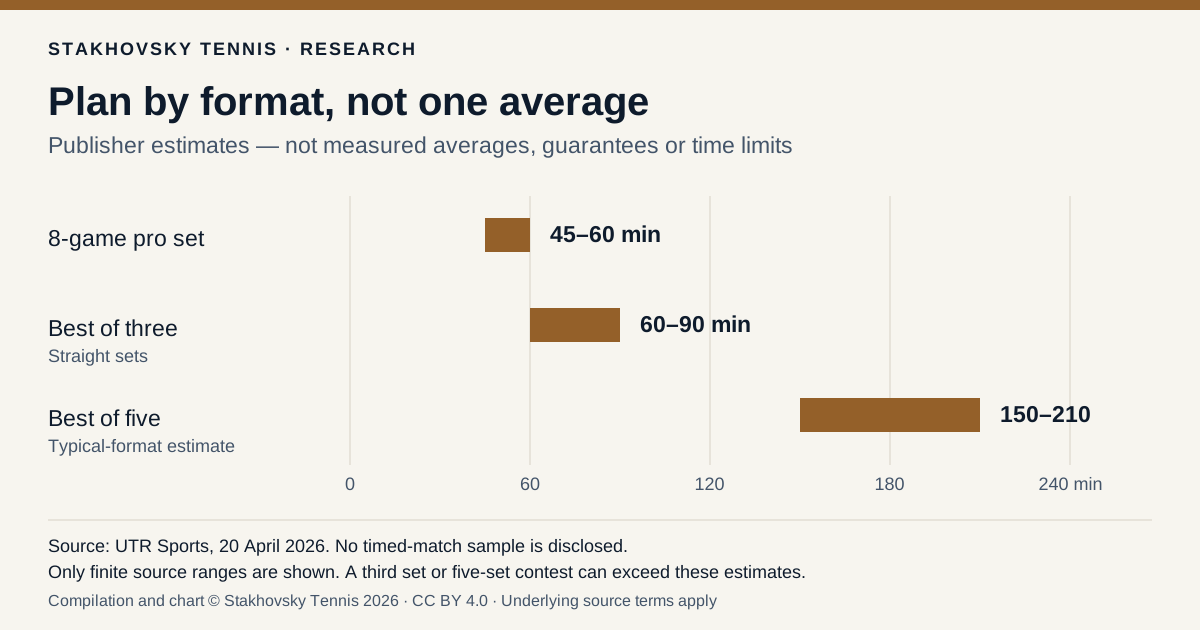
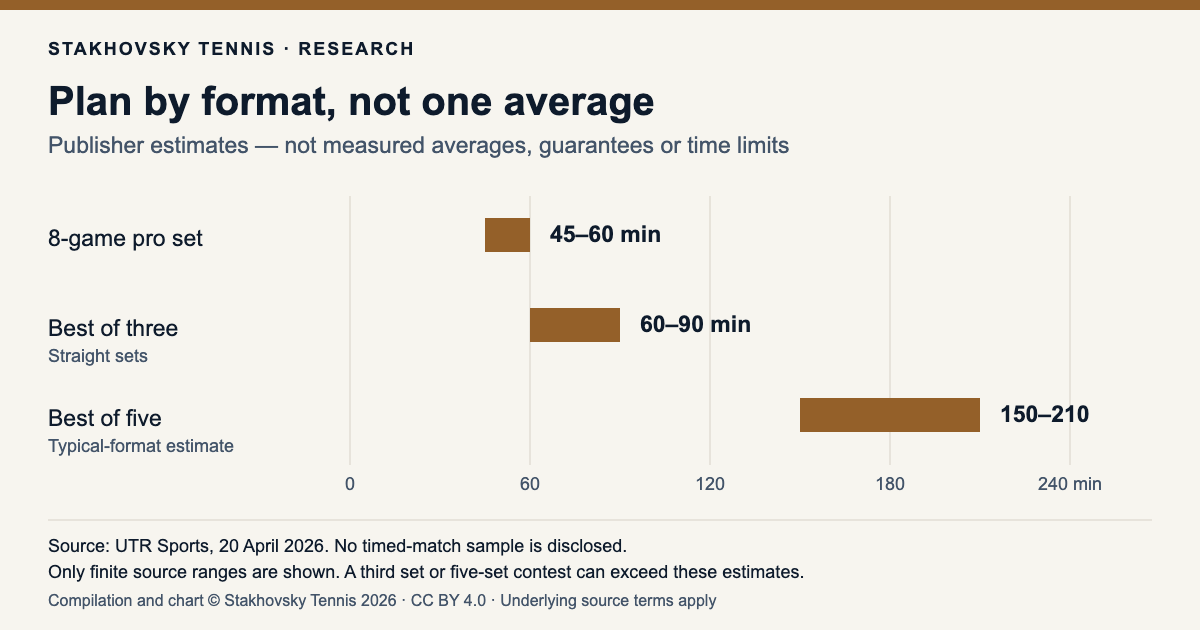
Tennis has no universal match time. For planning, UTR Sports' April 2026 guide estimates 60–90 minutes for a straight-sets best-of-three match and 150–210 minutes for a typical best-of-five match. Those are publisher estimates, not a disclosed 2026 match sample. Stakhovsky Tennis keeps them separate from historical professional data and the 11-hour, 5-minute Isner–Mahut match at Wimbledon in 2010.
- Match duration
- The source's reported match clock, including between-point and changeover time.
- Elapsed time
- The calendar span from starting to finishing, potentially including overnight delays.
- Ball-in-play time
- Time when points are being played, a subset of match duration.
- Booking allowance
- A reserved court slot, not proof that the match will finish within it.
How long is a tennis match by format?
First check how many sets are needed, whether games use advantage scoring and whether the deciding set is replaced by a match tiebreak. A league's timed format can be different again.
| Format or outcome | Publisher's time estimate | How to interpret it |
|---|---|---|
| Best of three, straight sets | 60–90 minutes | Two sets played; not an upper time limit |
| Best of three, deciding third set | 90 minutes to over 2 hours | Open-ended estimate, not a 120-minute cap |
| Best of five, typical estimate | 150–210 minutes | 2.5–3.5 hours; not specifically a five-set match |
| All five sets played | Can exceed 240 minutes | More than four hours is possible |
| 8-game pro set | 45–60 minutes | Shorter scoring format, not a guaranteed finish |
| Fast4 | Under 60 minutes in the guide | Check the competition's exact set and tiebreak rules |
Source: UTR Sports' match-length guide. Leave room for warm-up, delays and venue turnover when booking. A schedule is not a prediction for two particular players.
What do historical professional averages show?
The PTPA's 2024 Tennis Player Health Report presents these comparisons. Its summary does not fully specify all event inclusion rules or sample sizes, so we retain its categories and years. These are not current 2026 ATP or WTA averages.
| Report category | 1999 | Later observation | Later year |
|---|---|---|---|
| All matches | 98 | 119 | 2023 |
| All matches, 2024 report value | 98 | 120 | 2024 |
| All majors | 139 | 166 | 2023 |
| French Open | 143 | 175 | 2023 |
| Wimbledon | 136 | 160 | 2023 |
| US Open | 138 | 159 | 2023 |
| Australian Open | 139 | 179 | 2024 |
The displayed 98-to-120 comparison is about a 22.4% rise when calculated from the rounded endpoints. It is a historical report comparison, not proof that every tour, surface or player experienced that increase.
How long is a game or a set?
Neither has a fixed duration. Under ordinary advantage scoring, repeated deuces can extend a game. A close set can include long games and a tiebreak, while a one-sided set may finish much sooner. Dividing a match's duration by its games gives an allocation of match time, not a stopwatch measurement of a typical game.
A best-of-three match ends when one player wins two sets; best of five requires three. The 2026 Grand Slam rulebook specifies best of five for men's main-draw singles. Other draws and competitions can use different formats. For college planning, distinguish an individual match from the whole college team fixture.
Does the surface determine match length?
Surface can change the bounce and the patterns players choose, but it does not determine the finish time on its own. Score closeness, serve effectiveness, rally style, scoring rules and interruptions also matter. A quick clay-court win can be shorter than a closely contested grass-court match.
Do not treat a cross-event comparison as a controlled surface experiment. The PTPA's French Open, Wimbledon and US Open figures describe different tournaments and participants. For the difference between a fast delivery and an effective service game, see the serve-speed evidence guide.
How much match time is the ball actually in play?
A 2015 ITF coaching review by Sánchez-Alcaraz Martínez summarised historical studies reporting ball-in-play time between 16% and 29% of total match time. This is a literature range, not a measured percentage for every modern match.
| Measure | Value | Evidence class |
|---|---|---|
| Ball-in-play share of total time | 16–29% | Historical studies summarised in the 2015 review |
| Applying that range to 120 minutes | 19.2–34.8 minutes | Illustration: 120 × 0.16 to 120 × 0.29 |
The remaining time is not simply inactivity: it includes between-point routines, ball collection, changes of ends and other pauses within the source's definition. Training only for continuous hitting misses the stop-start structure, but this range alone cannot prescribe an individual's conditioning load.
What are the longest recorded tennis matches?
These independently sourced examples illustrate different categories. They are not a complete ranking of all matches, and an old record label should be read in the context of its source date.
| Match | Event | Duration | Scope and source |
|---|---|---|---|
| John Isner d. Nicolas Mahut | Wimbledon 2010, first round | 11 h 5 min (665 min) | Wimbledon compendium; played over 22–24 June, final set 70–68 |
| Tomas Berdych / Lukas Rosol d. Stanislas Wawrinka / Marco Chiudinelli | Davis Cup 2013, doubles | 7 h 1 min (421 min) | Davis Cup report, 2 February 2013; final set 24–22 |
| Novak Djokovic d. Rafael Nadal | Australian Open 2012, final | 5 h 53 min (353 min) | Australian Open history; identified as the longest Grand Slam final |
| Novak Djokovic d. Roger Federer | Wimbledon 2019, final | 4 h 57 min (297 min) | Wimbledon 2020 compendium; longest men's final at Wimbledon in that record |
| Francesca Schiavone d. Svetlana Kuznetsova | Australian Open 2011, fourth round | 4 h 44 min (284 min) | Australian Open historical list; women's event record, final set 16–14 |
Isner–Mahut's 665 minutes were spread across three dates, not 665 uninterrupted minutes. The distinction matters when comparing a scoreboard duration with a spectator's or player's calendar commitment.
Do final-set tiebreaks prevent matches lasting days?
No. A tiebreak changes the scoring, not the weather or the calendar. The Grand Slam Board's 16 March 2022 announcement introduced a 10-point tiebreak at 6–6 in the deciding set for the stated singles formats. A player still needs a two-point lead. The 2026 rulebook retains a 10-point final-set tiebreak.
| Rule or condition | Practical consequence |
|---|---|
| Deciding set reaches 6–6 | A 10-point tiebreak replaces an extended advantage set |
| Two-point winning margin | The tiebreak itself has no fixed maximum point count |
| Rain, darkness or other suspension | Completion may move to another day |
| Doubles, qualifying or junior event | Read that event's format; some use a match tiebreak instead of a full deciding set |
A 70–68 deciding set cannot occur under that 6–6 tiebreak format. It does not follow that every match finishes the same day or within a set number of hours. The rulebook also provides for suspension of play.
How long should club and junior players book?
Ask the organiser about the scoring format and booking policy, then allow for warm-up and changeover. A tournament round, a timed league match and a practice set are different appointments. Level alone does not provide a reliable finish time.
For one specific example, USTA Eastern's Western Region 2026 regulations require two hours of court time in the stated league provisions. Buffalo's timed-match procedures use a 1-hour, 55-minute threshold, while the document says timed procedures do not apply in Binghamton, Ithaca, Rochester and Syracuse. This is not a nationwide USTA duration rule.
Junior event formats vary with age and competition. Check the entry information before planning travel, schoolwork or another match. The junior competition pathway and tennis levels guide address different parts of that planning decision.
What does match length mean for training?
Build the plan around the player's actual competition format and match evidence. Record when decision-making, movement or serve reliability changes, rather than treating a tour average as a compulsory training duration.
| Report measure | No injury reported | Injury reported |
|---|---|---|
| Mean match duration | 109 minutes | 122 minutes |
| Minutes played in the preceding month | 343 minutes | 461 minutes |
The PTPA report does not establish that an extra minute caused injury or give a safe training threshold. This page is not medical advice. An individual load or return-to-play decision needs appropriate professional assessment.
First-party case, not a general outcome: the Cinar performance-block case study reports a court-coverage drill changing from 38.05 to 30.10 seconds and a 60-touch endurance drill from 3:17 to 3:01. Those are specific test results, not evidence of a quantified recovery improvement or a promise for another player.
A 90-minute assessment in Prague costs 3,800 CZK (≈ €155), with court fees extra. The fee is credited toward the first programme period if the player continues. Use the published pricing and scope to plan the next step; training blocks are quoted separately. The performance-training page explains the coaching format.
Method and limitations
Stakhovsky Tennis reviewed the linked publications and event records on 11 October 2026. This editorial compilation is not original match timing research. It preserves the year and scope of each observation, and separates measured reports, publisher estimates, rules and arithmetic illustrations.
- UTR Sports' guidance is not a disclosed sample of timed matches.
- The PTPA summary has incomplete methodological detail; its historical categories are not relabelled as current tour averages.
- The 2015 ball-in-play review combines earlier studies, not a modern controlled surface comparison.
- The marathon table is selective. A dated event record is not proof of a complete current world ranking.
- Regional league scheduling and court bookings are not universal match-duration limits.
Original Stakhovsky Tennis compilation, chart design and annotations are licensed under CC BY 4.0. Third-party content remains subject to its source terms. Cited organisations are not presented as endorsing the article.
Download the match-length source extract
The CSV and JSON contain 30 numeric observations or ranges, with source periods, units and use limits. Open-ended guidance is explicitly marked and is not exported as a finite maximum. Scoring rules remain in the article and official rulebook rather than being disguised as measured duration data.
Frequently asked questions
How long is a tennis match?
There is no fixed time. UTR Sports' April 2026 guide estimates 60–90 minutes for a straight-sets best-of-three match and 150–210 minutes for a typical best-of-five match. These are planning estimates, not time limits or a disclosed measured sample.
What is the average professional tennis match length?
The PTPA's 2024 report lists 120 minutes in its all-matches category, compared with 98 in 1999. The report does not fully disclose the category's sampling rules. It is a historical observation, not a universal 2026 ATP or WTA average.
How long is one game in tennis?
A game has no fixed duration. Repeated deuces can extend advantage-scoring games. Dividing total match minutes by the number of games allocates the whole match clock; it does not directly measure a typical game.
How long is a set in tennis?
A set has no standard number of minutes. Its duration depends on the number of games, deuce points, rallies, pauses and any tiebreak. The scoring format matters more than an unsupported universal time estimate.
How long is a Grand Slam match?
Men's main-draw singles use best of five sets under the 2026 Grand Slam rulebook. Other events have their own formats. A typical-format planning estimate does not guarantee a finish time, and delays can extend the calendar span.
What was the longest tennis match?
Wimbledon's records identify John Isner's 2010 first-round win over Nicolas Mahut at 11 hours 5 minutes, played across 22–24 June. Isner won the deciding set 70–68 under the advantage-set rules then in use.
What was the longest Grand Slam final?
The Australian Open identifies Novak Djokovic's win over Rafael Nadal in the 2012 final as the longest Grand Slam final, at 5 hours 53 minutes. Djokovic won in five sets.
Are tennis matches getting longer?
The PTPA's historical summary reports an increase from 98 minutes in 1999 to 120 in 2024 in its all-matches category. That comparison does not establish a current trend for every competition, format or player.
How many sets are played in a tennis match?
Best of three requires two sets to win, and best of five requires three. Some competitions use short sets or replace a deciding set with a match tiebreak. Check the rules of the specific event.
How much time is the ball in play?
A 2015 ITF review summarised historical studies reporting 16–29% of total match time. Applying that range to a hypothetical two-hour match gives 19.2–34.8 minutes. That calculation is not a measured result for every two-hour match.
How long is a USTA league match?
There is no single national duration rule established here. USTA Eastern's Western Region 2026 regulations include two-hour court provision and specific Buffalo timed-match procedures. Other local rules in the same document differ.
Can a tennis match still last several days?
Yes. Rain, darkness or other suspensions can move completion to another day. A final-set tiebreak at 6–6 prevents an extended advantage set, but it is not a fixed time cap and still requires a two-point margin.
Sources and how to cite the data
- UTR Sports, match-format guidance, 20 April 2026
- PTPA, Tennis Player Health Report, 2024, page 4
- Sánchez-Alcaraz Martínez, Temporal structure in tennis competition, 2015
- Wimbledon 2020 compendium: Isner–Mahut and the 2019 men's final
- Davis Cup, Czechs outlast Switzerland in epic, 2 February 2013
- Australian Open: the 2012 final
- Australian Open: historical match-duration list
- Grand Slam Board, final-set tiebreak announcement, 16 March 2022
- Official Grand Slam Rule Book 2026
- USTA Eastern, Western Region 2026 local regulations
Cite the original report and period for a statistic, plus Stakhovsky Tennis when using this compilation or its chart. For example: “PTPA (2024), Tennis Player Health Report, p. 4; selected comparison compiled by Stakhovsky Tennis (2026), MTL-01.”